
The Next Inflection Is the Lab
In drug discovery, the moat is the measurement, not the model.

On August 5, Jeff Dean left Google after twenty-seven years. He didn’t leave to build another model. He left to co-found Discovery Loop, a public-benefit corporation whose stated purpose is to automate complex, multi-step science experiments end to end, with Oriol Vinyals, Quoc Le, and Sanjay Ghemawat as co-founders and Google itself as founding investor, cloud partner, and supplier of the first year of compute.
The same day, Demis Hassabis handed off day-to-day control of Google DeepMind, took its chair and Alphabet’s chief-scientist role, and said he would lean further into Isomorphic Labs, the drug company he spun out of DeepMind. Alphabet fell about five percent. And a week before either of those, DeepMind had disbanded the team behind AlphaFold, the work that won the 2024 Nobel Prize in Chemistry, and dispersed it into Gemini and into Isomorphic. John Jumper, who shared that Nobel, had already left for Anthropic in June.
Three moves, one week, all pointing the same direction: away from building the model, toward running the experiment.
I’ve been sitting on this note for a while. I held it through July on purpose. I didn’t want to put a thesis measured in years in front of people in the middle of a high-beta drawdown, when the tape is punishing anything that asks for patience and nobody wants to hear about a decade. After this week, waiting stopped making sense.
It’s still a strange thing for me to be writing about.
If you subscribe to me, you subscribe for semiconductors. Memory, optics, packaging, power, the physical layers the AI buildout has to pass through. So this note owes you an explanation, because I’m about to spend it on drug discovery, and I want you to see that it isn’t a departure. It’s the same trade, one layer of the economy over.
I didn’t come to this as an investor. I came to it after I lost both of my parents to cancer. My mother’s doctor had found a Phase 2 drug for her. The company wouldn’t manufacture it for compassionate use. That’s the part I’ve never been able to put down: the molecule existed, it had a name, and the reason she couldn’t have it was that nobody would make it. I’ve spent enough time in cancer clinics to not wish them on anyone, and to notice that most of what gets handed out there buys time rather than a cure. Standing in that gap turned private grief into a question: what’s actually broken inside biotech, and is any of it about to change? I went looking with the same lens I bring to chips, and I found the same structure underneath.
The reason this stopped feeling abstract came out of the world I actually cover. In June, three days after Anthropic launched its most capable model, the U.S. government invoked export-control authority and ordered access to Mythos suspended for every foreign national overnight. It was walked back weeks later, but the lesson wasn’t: companies that had built their products around a model they only rented watched a decision made in another building switch it off.
Alex Karp put the sharp version on CNBC on July 1, enterprises renting frontier models get “no value” while the labs “get my IP,” and what customers actually want is “control over their compute, their models, their data stack, and their alpha.” Weeks earlier Anthropic had blindsided its own partner Figma by shipping a near-identical tool of its own. The model you rent, fed by the data you hand over, becomes the product that replaces you.
I made the enterprise version of this case in December, in NVIDIA Nemotron 3: “own the data, customize the model, and eliminate vendor lock-in.” Your data should work for you, not train someone else’s model and put you out of business.
Which brings me to what almost nobody is pricing yet. The next place that rule bites hardest is science, where owning your model is inseparable from owning the instrument that generates its data, the lab bench itself. And this has stopped being only a corporate question. China has made biotechnology a national project, with a declared goal of leading the global bioeconomy by 2035 and biomanufacturing named a strategic priority in its latest five-year plan. Whoever owns the measurement layer, the instruments and the proprietary data they throw off, owns the raw material of biological AI. That isn’t a race the United States can afford to rent its way through, even though the same instrument makers book real revenue inside China today, which means a hard decoupling would cut both ways. This isn’t hypothetical, and it’s worth knowing which instruments are already in scope. In January 2025 the U.S. put export controls on high-parameter flow cytometers and certain mass-spectrometry equipment, explicitly because that hardware generates the high-quality biological data that trains AI models. That isn’t a distant category. It’s Bruker’s timsTOF, Thermo’s Orbitrap, Beckman inside Danaher, the exact franchises this note is about. China then blocked Illumina’s sequencers on its side. I’d not be surprised to see controls eventually reach further into the instrument stack, and it’s a two-way risk on the very names I’m telling you to own.
The Bottleneck Always Migrates
Here is the thing I keep coming back to in my own coverage. The bottleneck isn’t the GPUs. It’s powered land, and then getting the thing into the datacenter, the build-out and the people actually doing the building. It’s a physical constraint, not a compute one. Once you have enough compute the whole thing settles down, but right now the problem is getting enough electricians and contractors onto sites without the neighbors complaining and stalling the project. That’s what the constraint actually looks like when you go stand next to it.
The market fixates on the glamorous layer and misprices that. In datacenters the constraint was never really the GPU; it migrated to memory, to CoWoS packaging, to power, and the durable way to own that buildout was the layer every buyer had to pass through no matter which model or hyperscaler won. I made that argument most directly in The Watt Tax: “This is the trade. Not the valuation argument. The bottleneck.” Find the layer that gates everything, own it, and you stop having to guess the winner. That rule now points at a lab bench.
Why Biology Is the Hardest Business in the World
There’s just a lot of people, and time, and experimentation, to get to one molecule. And a lot of the real cost isn’t even there, it’s in the clinical trials. But if you can model that with AI, or model the human body with enough compute, maybe some of it speeds up and we get to cures faster. That’s the whole bet, and I want to be careful not to oversell it.
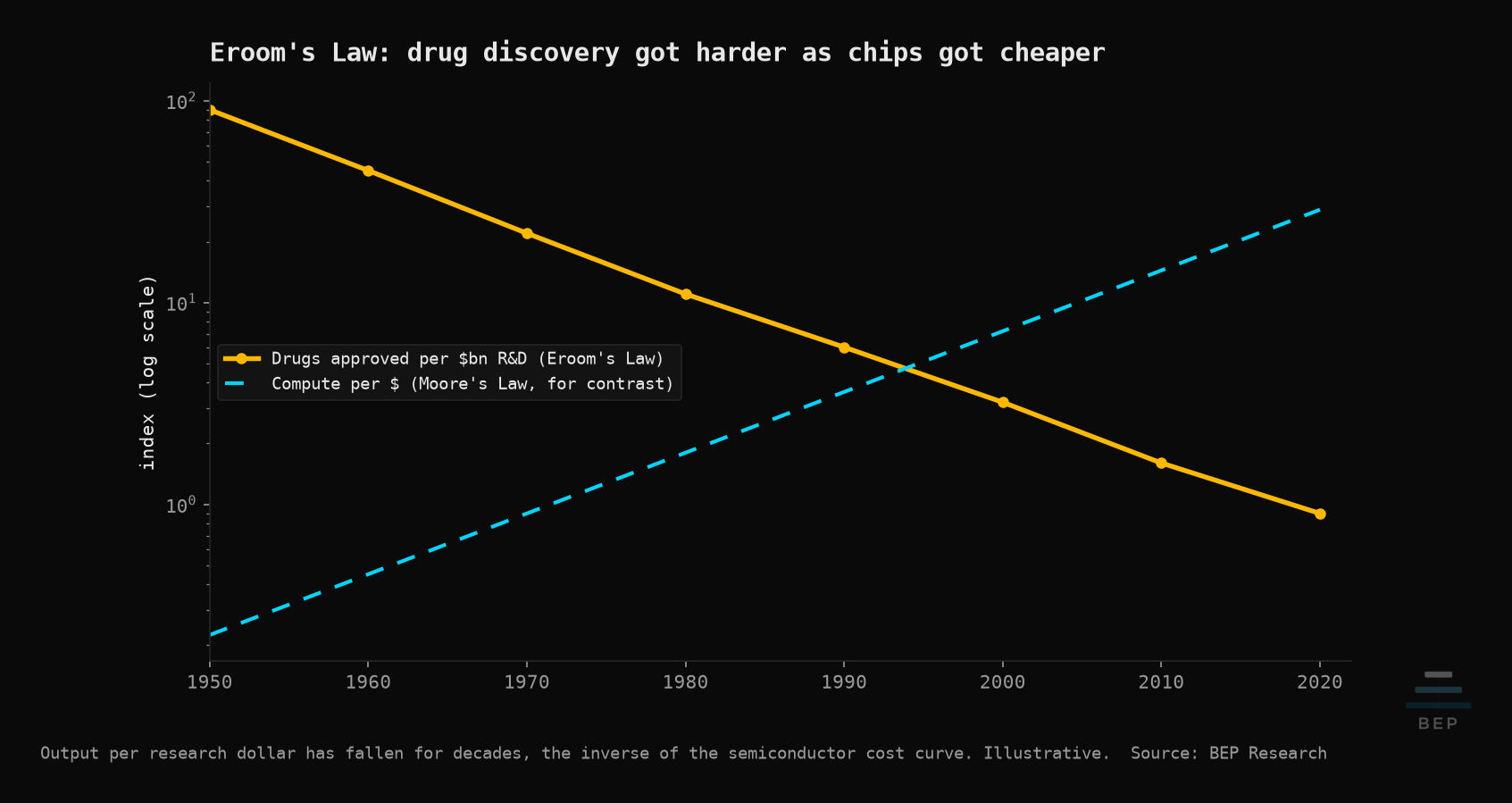
Start with the economics, because they would horrify any semiconductor investor. It takes ten to fifteen years and well over a billion dollars to bring one drug to market. Roughly nine of every ten that reach human trials fail, most in Phase 2, after most of the money is already spent. And drugs approved per research dollar has fallen for decades, an unsolved bottleneck with a name: Eroom’s Law, Moore’s Law spelled backwards, the exact inverse of the cost curve that made everything we cover cheap. Unsolved bottlenecks, when a new tool finally cracks them, are where outsized returns have historically hidden.
The Lab Is a Loop
The simplest way I think about it’s inventing a better key for a lock. A computer can imagine thousands of keys. Somebody still has to cut the metal and test whether it turns. The slow, painful, expensive part is cutting the metal and finding out.
The mental model that organizes the sector is a loop. A modern discovery lab is a closed loop with four steps: Design (an AI proposes a molecule), Make (it gets synthesized), Test (instruments measure what it actually does), Learn (the result trains the next design). Every AI-drug-discovery company is a race to spin that loop faster.
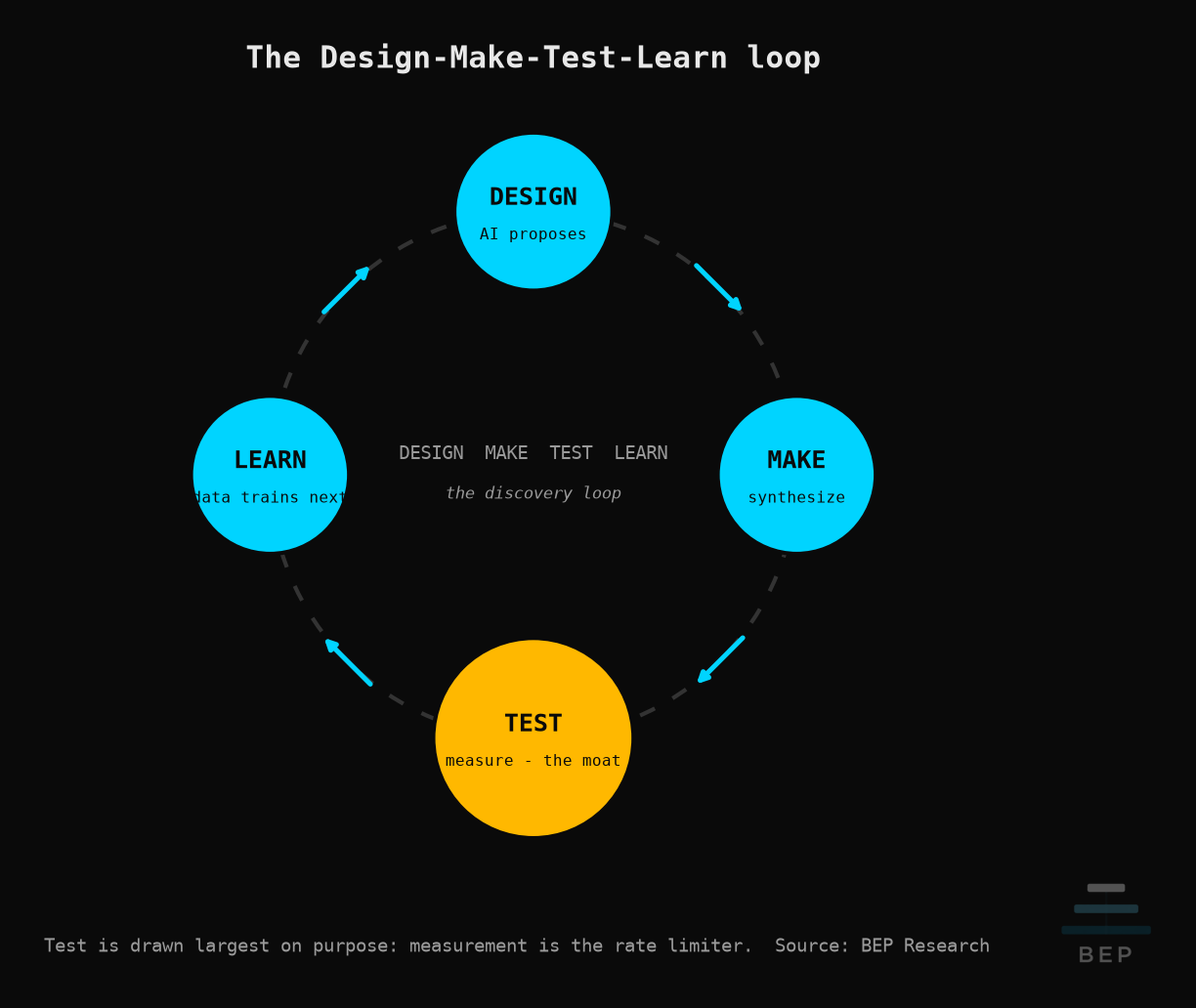
And here is the part the market has backwards. Venture money, headlines, and the Nobel all flow to Design, the model. But Design is the least constrained step: models diffuse in months, every lab rents the same GPUs, the algorithms are nearly a public good. The binding constraint is Test, physically finding out which molecules actually bind, fold, permeate, and don’t kill a cell, on instruments only a handful of companies can build. The scarce input to a great biology model isn’t compute but measured data at scale. The moat is the measurement.
The Stack, One Layer at a Time
To see where the value sits, you have to see what actually happens at each station of the loop. What follows is the whole machine in plain language, nine layers, following a molecule from idea to drug. The full primer and the interactive map take each one apart; this is one level down from the headline.
Before the walk, where my own attention actually goes. Design, make, and the hands are the most interesting to me. The top half of the stack is the meat. Make especially, because of companies like Twist and IDT and GenScript: you’re about to have so many things you could build and test that the world is your oyster. You start making more and more of them and hoping one of them hits. That’s really the point for me. When AI makes ideas cheap, somebody still has to absorb all of that physical throughput. That’s where the make layer gets interesting, and it’s why I moved weight into it this week.
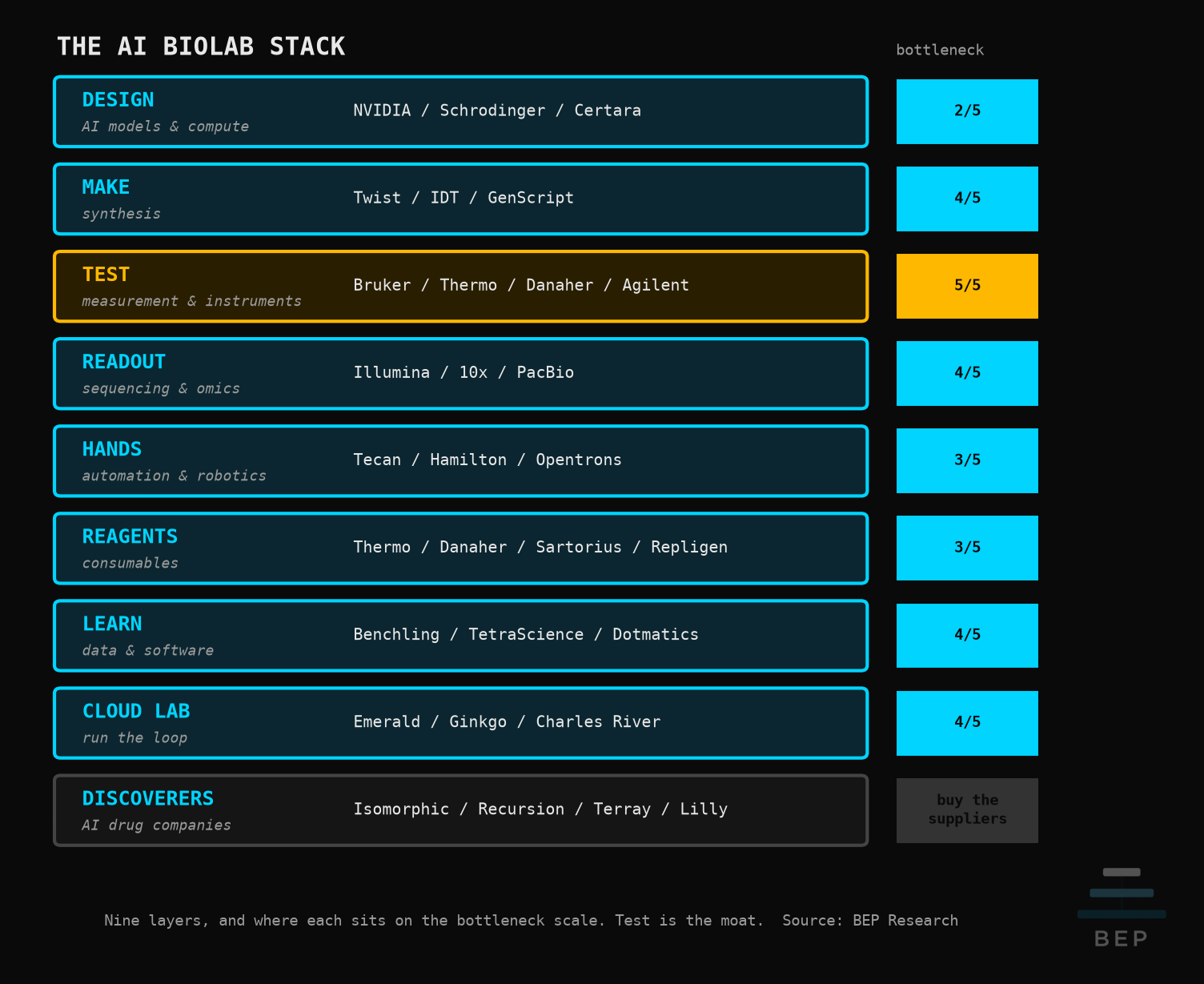
1. Design, where the computer dreams up the molecule. A drug is a small object that has to fit against a much larger one, usually a protein, the folded machine inside a cell that a disease has broken. For fifty years the hard part was seeing the protein’s exact 3D shape. In 2020, an AI called AlphaFold largely cracked the folding problem, predicting a protein’s shape from its sequence alone, work that won the 2024 Nobel in chemistry. Now software can invent candidate molecules to fit that shape by the million, for the cost of electricity. This is the glamorous layer everyone funds. It’s also the least defensible, because the models leak out into the world within months. Underneath all of it sits NVIDIA, whose chips and software (BioNeMo) run everyone’s models. The durable position here is the toll road underneath, not the car riding on it.
2. Make, where the design becomes real matter. A molecule on a screen is worthless until someone physically builds it. That means writing custom DNA base by base, or synthesizing a compound step by step. It’s slower and harder than it sounds, and turning a digital idea into a physical sample can still take weeks. The companies that endure here, like Twist Bioscience, are the ones that sell a consumable you reorder forever, not a clever machine you buy once. The graveyard of this layer (Amyris, Zymergen) is full of impressive platforms that had no repeat-purchase razor underneath them.
3. Test, where you find out if it actually works. This is the one that matters. A model can guess that a molecule will work. Knowing requires physically measuring the real thing against a real target: does it bind, does it fold, does it poison a cell? That measurement happens on instruments that cost as much as houses, a mass spectrometer that weighs molecules, an NMR machine that reads their structure with a superconducting magnet, a cryo-electron microscope that photographs a frozen protein atom by atom. Only a handful of companies on earth can build these, and the science is decades deep. Bruker has a near-monopoly on research NMR; Thermo Fisher owns the high-end microscopes and mass specs. This is the layer that produces the measured data every AI model is starving for, and it’s the hardest in the stack to copy. It’s the moat.
4. Readout, where you read biology directly. Related to Test, but pointed at reading the code of life itself, sequencing DNA, counting the proteins in a cell. Reading DNA is now cheap and industrialized, an Illumina near-monopoly under attack from cheaper rivals. Reading proteins, which are what drugs actually act on, is still unsolved, and that frontier is where the newer public names are fighting.
5. Hands, the robots that run the experiments. Someone has to move the liquids, load the plates, and run the machines thousands of times, and increasingly that someone is a robot. But the robot arm is becoming a commodity. The real value, and the real lock-in, is the scheduling software that tells a whole room of instruments what to do and when. Most of the best names here are still private.
6. Reagents, the sugar and cups of science. Every experiment burns physical supplies: the chemicals, the antibodies, the cell food, the plastic tips and dishes. They get used up and reordered, forever. This is the beautiful part for an investor: as AI lets scientists run far more experiments, they burn far more supplies, whether or not any given experiment succeeds. The model doesn’t have to be right for the reagents to sell. It’s a toll on scientific activity itself, and it’s concentrated in a few giants like Thermo Fisher and Danaher.
7. Learn, the memory of the whole loop. All that measured data is worthless if it’s scattered across incompatible machines and formats. The software that captures, cleans, and organizes a lab’s experiments into something an AI can actually learn from is one of the most valuable layers, because whoever becomes the system of record for that data sits at the center of what everyone’s models train on. It’s scarce enough that Siemens paid $5.1 billion for one of these companies (Dotmatics), and another (Benchling) is privately valued near $6 billion.
8. Cloud Lab, renting the whole loop. A handful of companies will now run the entire physical loop for you: you write an experiment as code, their robots run it, and the data comes back, no lab of your own required. The truly “self-driving” version, where the AI itself decides the next experiment, is real but still early, and mostly confined to a few labs. Public exposure here is mostly the big contract research organizations that already run trials for pharma.
9. The Discoverers, the drug companies themselves. Finally, the tenants that assemble the whole stack to actually find medicines, Isomorphic, Recursion, Terray, and dozens more. This is where the headlines and the dreams live. It’s also where the risk lives, because a brilliant platform can still watch its one drug fail in a trial and go to nearly zero. This is the lottery ticket. It isn’t the durable position, which is the whole point of everything above it.
What Terray Showed Me
My conviction didn’t come from a spreadsheet. It came from standing in a room. I’m an angel investor in Terray Therapeutics, and Jacob Berlin walked me through their Los Angeles lab.
The first thing that struck me was that it was quiet. I had expected something industrial. What I got were trays of custom-built, ultra-dense microarrays, each one a grid of microscopic wells, synthesizing and reading chemistry at a scale I couldn’t really hold in my head, and feeding all of it back into the models. On the company’s own figures that runs to roughly a billion unique measurements a quarter, more than three times the entirety of public chemistry data every three months. It felt like an agentic molecule factory, working through combinations that had never existed before.
Humans still set the trays up today. That’s worth saying plainly, because the phrase “self-driving lab” gets thrown around loosely and we aren’t there yet. But seeing it in person is what opened my eyes to the lab in the loop, and to what happens when that last human step goes away. If you have robots and machinery running experiments around the clock, while you’re sleeping, through the weekend, millions of iterations, you generate an amount of data no human-paced lab can approach. Then you comb through it for the needle in the haystack. The bottleneck I had assumed was permanent started looking like an engineering problem.
Why Now, and Not Five Years Ago
The tell that an inflection is real is who starts spending to own it. This summer, the answer was everyone. NVIDIA shipped its BioNeMo Agent Toolkit at the BIO convention, OpenAI released LifeSci-Bench, and Anthropic, the maker of Claude, bought Coefficient Bio, a drug-discovery team of ex-Genentech researchers, for roughly four hundred million dollars, its largest acquisition.
Then the people moved, which is a louder signal than the money, and it’s where I started this note. Dean to Discovery Loop, whose roadmap runs from machine-learning research into hardware design, drug discovery and clean energy. Hassabis stepping back from running DeepMind to lean into a drug company. The AlphaFold team dispersed.
I’ll not pretend to be neutral about this. It felt like validation of where my head has been for months. Dean named the company Discovery Loop. That’s the same four-step diagram I drew a few sections ago, and he left the best AI lab in the world to go automate it rather than to build another model. Hassabis, meanwhile, won a Nobel for predicting protein structure and has now chosen the drug pipeline over the lab that won it. I’d not read the five percent too hard; the market is rational and irrational by turns, and a few departures don’t define a company that size. What matters is that the two people with the best information about what AI can do next both looked at the field and walked toward the bench.
My read on the AlphaFold breakup is less dramatic than the headlines. Once a company gets big enough it becomes too many things. IBM ended up spanning transistors, consulting, cloud and quantum, and at that size office politics and competing priorities make it hard to have impact. I think these people wanted to build something focused, where they could move faster. That’s a more ordinary explanation than betrayal, and I suspect it’s the right one. But the investment consequence is the same either way. A lab won the highest honor in science for a model, published it for free, and less than two years later its own owner concluded the team was worth more dispersed than together. Whatever the motive, the durable seat was never the structure predictor. It’s the pipeline those predictions feed and the instruments that check them.
And then, on August 6, while I was finishing this, the cleanest illustration of the entire argument arrived from Stanford and the Arc Institute. A generative model called Evo designed complete viral genomes from scratch, the first time whole genomes have been written by an AI rather than copied from nature. The team took 285 of those designs, physically synthesized them, and put them in a dish.
Sixteen worked.
That ratio is the thesis of this note, run as an experiment by someone else and published in a journal. The model generated 285 plausible genomes at essentially zero marginal cost, and roughly ninety-four percent of them were dead on arrival. There was no way to know which sixteen were alive except to write all 285 into physical DNA and test them on a bench. Design was the cheap half. The truth was only available by measurement. And note what those 285 were, commercially: 285 synthesis orders and 285 assays, which is the demand curve I’ve been describing all the way through this note, showing up in a single experiment.
Be careful with the headlines on this one, because the scary reading is close to the opposite of the science. The work, led by Brian Hie at Stanford and published in Science, used the Evo models trained on the genomes of roughly two million bacteriophages. Bacteriophages infect bacteria, not people. The genetic code of viruses that infect humans, animals, or plants was deliberately excluded from the training data, so the model can’t design one. What the AI-designed phage cocktail actually did was clear E. coli that natural bacteriophages could no longer kill. That isn’t a weapon. That’s a candidate therapy for antibiotic-resistant infection, one of the genuinely unsolved problems in medicine, and the first time a medicine of that class has been designed end to end by a model and then proven at a bench.
The biosecurity concern is real and I’m not going to wave it away, but read where the experts actually point. The Johns Hopkins Center for Health Security, writing alongside the paper, warned that the ability to compose viral genomes with generative AI now exists while “the governance to safely steer it does not.” Tom Ellis at Imperial called this the smallest and easiest genome there’s to make, and argued the AI-design threat is overblown next to the far easier path of modifying pathogens that already exist. And Filippa Lentzos at King’s College London made the point that matters most for this note: the highest-leverage place to intervene isn’t the model at all, it’s the moment DNA is physically manufactured, through synthesis screening. Even the people whose job is to worry about misuse conclude that the control point sits in the physical layer rather than the digital one. That’s the same conclusion this note reaches from the other direction, for money instead of safety.
And the data owners aren’t going quietly, which is the tell that the data is the asset. On the All-In podcast this month, David Friedberg, who runs the crop-genomics company Ohalo, described Anthropic approaching large life-sciences companies to pool their proprietary data into a new model in exchange for early access and an NDA. His read, and nearly everyone’s he had spoken with: they’re “basically trying to commoditize everyone’s business.” A drug company’s experiments produce the one asset it owns, so they’re saying no and building their own models instead. They have worked out where the scarce asset sits, and it isn’t the model.
I want to be fair about one thing here, because my own first read was wrong. I assumed Anthropic was moving in as a competitor to the discovery companies. Talking it through with people closer to it than me, the picture is more specific: a lot of that effort is pointed at orphan and neglected diseases, the ones the current economics simply don’t fund, using AI for a problem nobody else is paying to solve. That’s a refreshing thing to find at the end of a cynical line of reasoning, and it doesn’t change the structural argument. The data still belongs to whoever measured it. But not every model lab entering biology is trying to eat its partners, and I’d rather say that than run the tidier version.
No fully AI-designed drug has yet won FDA approval. That gap is the whole reason I’m writing this. Design raced ahead; the wet-lab validation that actually proves a molecule works hasn’t. Which is exactly where the value is.
Where I Part Ways
It’s more of a picks-and-shovels play, because you don’t know who is going to win, or even who survives if all of this works. That’s the honest starting point. You would rather own the tools and the instrumentation layer, have all of them buy into it, and then you get to win regardless of which one of them turns out to be right.
The intuitive version of this trade is to buy the drug hunters. If AI is going to transform medicine, own the companies using AI to find medicines. I think that’s the wrong expression, because it asks you to be right about a molecule, and being right about a molecule is a coin flip with a ten-year settlement date. Own the bench instead and you get paid on the attempt.
The second consensus is newer and much louder this month: the tools layer is broken. Orders are soft, budgets are tight, sell-side has been cutting, and Bruker just printed a revenue miss against a full-year organic growth guide of one to two percent. I part ways there, and this is the part I’d push hardest on. The tools layer isn’t one exposure. It’s two, running on different clocks. Instruments are capital expenditure, approved once by a committee and deferrable in a lean year, and they’re genuinely cyclical. Consumables are a toll on activity, spent per experiment and reordered next week whether or not anything worked. Those two halves reported within a day of each other this week. One beat its guidance, grew twenty-three percent and raised the year. The other missed and left the year where it was. Own the layer as a single bet and you will conclude the thesis is breaking. Own it as two and you will notice the activity half is compounding for exactly the reason I’m writing this note, which is that models are designing more molecules and somebody has to physically make them.
What this doesn’t require: that any particular drug works, that AI cures anything, that a self-driving lab arrives on schedule, or that you have a view on AGI. It requires one thing. That the number of physical experiments run per year keeps going up.
Two Ways to Go Deeper
I mapped this the way I map any supply chain. The whole thing, how a medicine gets made and how the modern lab works end to end, all nine layers with every meaningful company placed, lives as its own 50-page primer, free to read:
→ The Future of Drug Discovery Is AI-Assisted: the full-stack primer
If you would rather click through the map than read it, the whole stack is also an interactive tool, every layer and company, public and private, filterable in one view, free to explore:
→ The AI Biolab: the interactive supply-chain map
And one more, which is the one I’d actually use if I were you. The framework underneath all of this, the way I score a layer and hunt for the bottleneck, is written up as a file you can hand to an AI and work with yourself. Drop it in a project folder as CLAUDE.md and point Claude Code, or any agent that reads it, at filings, transcripts, decks, or your own notes. It encodes the method: the bottleneck migrates, own the toll not the coin flip, separate capex from consumables, what diffuses can’t be a moat. There are no positions or price targets in it, deliberately. It’s a way of thinking, not my book, and I’d rather you build your own conclusions with it than borrow mine:
→ The research framework (CLAUDE.md, free)
The Basket, and How to Watch It Live
People ask me to just name the one stock. The reason it’s a basket is the same problem as everything else here: you don’t know exactly who is going to win. A basket costs you some upside if one name absolutely dominates. What it buys you is exposure to the layer without pretending you know the single winner ahead of time. I will take that trade.
The honest way to express this is a basket, not a single pick. You can’t know which molecule wins, so you own the bench every discoverer has to buy from no matter whose drug does, weighted toward the moat and sized so the book is roughly right about the theme even when it’s wrong about any single name.
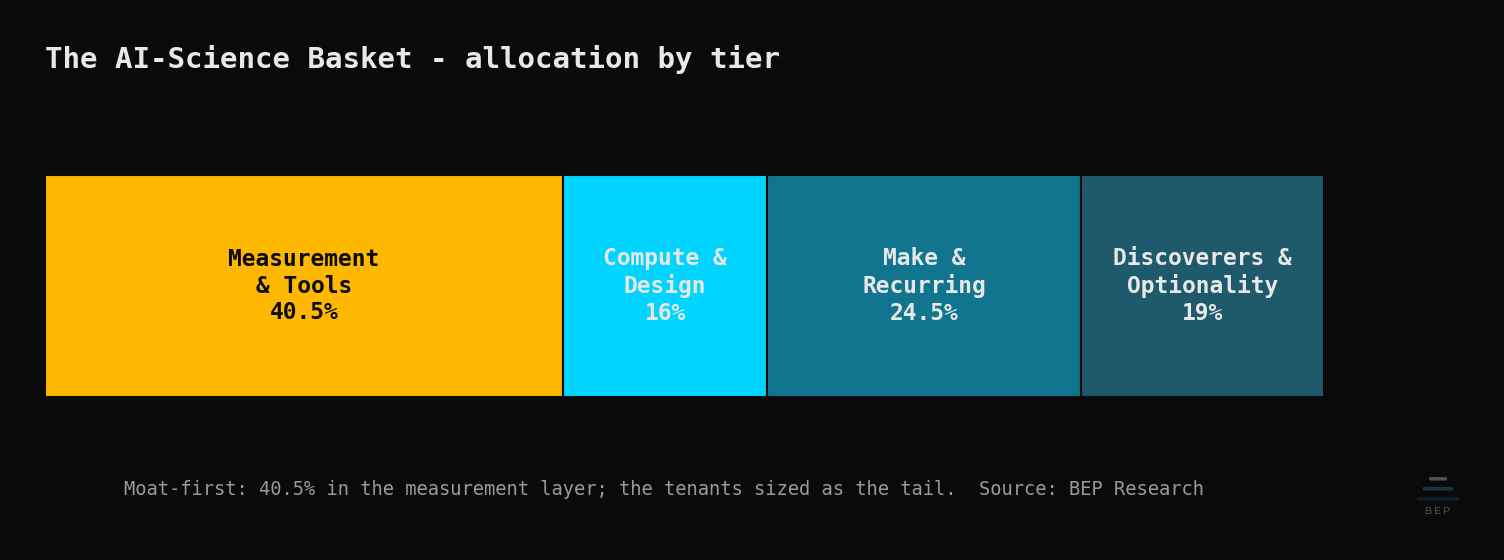
Three anchors give the shape of it, the purest picks-and-shovels seats in the book:
Bruker (BRKR) — NMR near-monopoly plus timsTOF single-cell proteomics, and a semiconductor-metrology leg riding a second capex wave.
Thermo Fisher (TMO) — cryo-EM, Orbitrap mass spec, and the widest consumables annuity in the industry.
NVIDIA (NVDA) — the neutral compute toll under the in-silico layer; it collects no matter which model or drug wins.
And the thesis isn’t static. On July 20, Tempus agreed to buy Personalis for a $1.5 billion enterprise value, a data-layer company paying up to own an ultrasensitive cancer-monitoring test outright, the measurement itself. That’s this entire argument, happening in real time.
The book isn’t a static list either. It runs as a live, rebased scoreboard so you can watch the whole thesis compound (or not) against the S&P 500 and biotech (XBI) in one view:
→ The AI-Science Basket: live performance tracker
That’s the shape and the scoreboard. Behind the paywall is the actual book: all twenty names with weights and the one-line case for each, the framework that turns “own the bench” into position sizes, and the ranked ways this thesis is wrong. This is the part that doesn’t survive being given away for free.
