

The Watt Tax
The bottleneck trade I am taking, called for paid subscribers only. Speculative follow-up to The Watt Asymmetry.

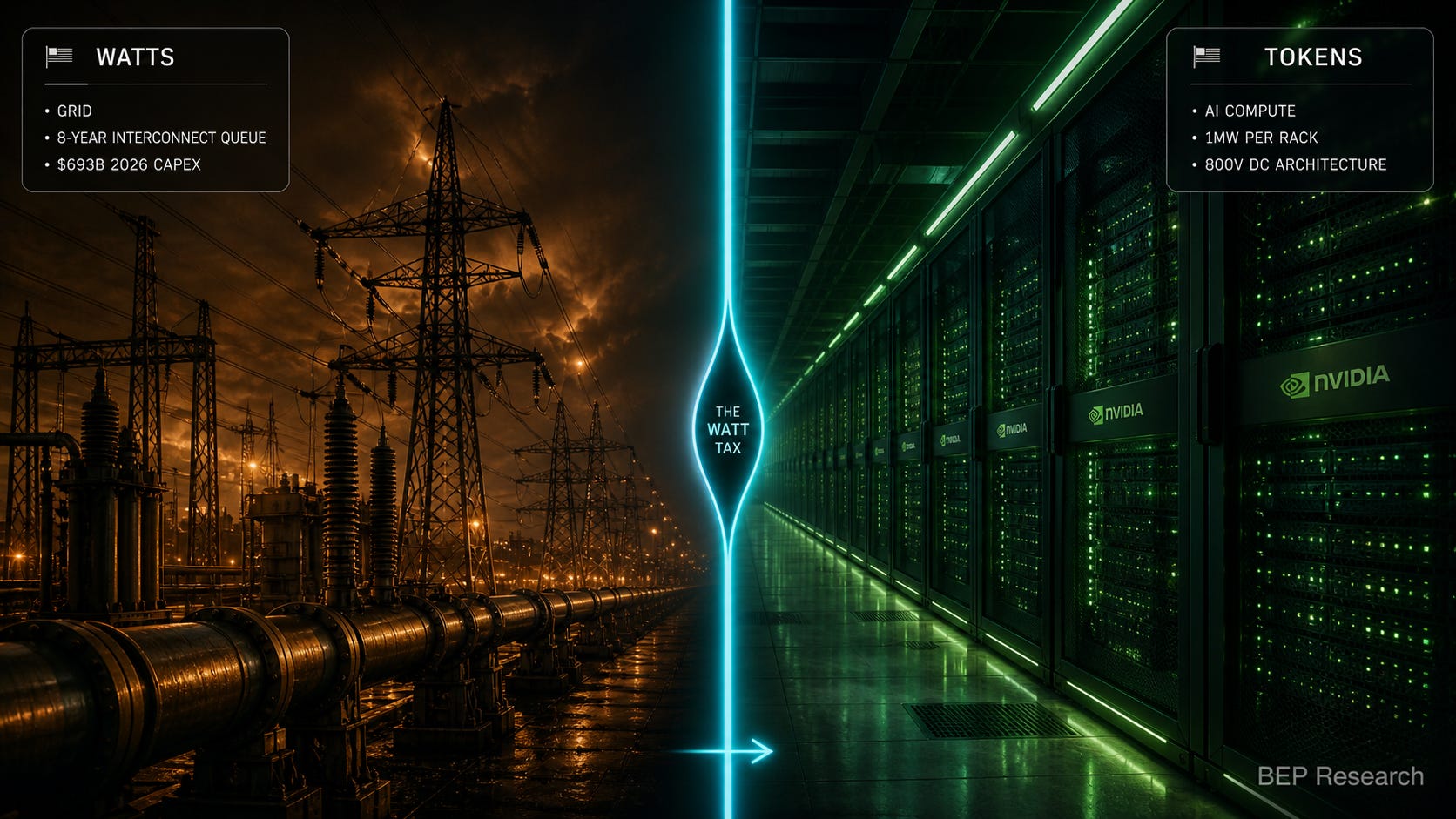
This piece is for paid subscribers only. The idea is in the body. The reason this is paid-only is structural, not promotional: the asymmetric setup that makes this position worth taking does not survive a public reveal. Float is thin. Short interest is heavy. The path-of-trade depends on subscribers acting on the framework before the next wave of capital prices it through. I am taking the position myself.
The Watt Asymmetry parent piece named six layers, three names, and one binding constraint: the megawatt rack on a US grid that will not interconnect new load for eight years. Nvidia, Eaton, Bloom carry the framework across silicon, power distribution, and behind-the-meter generation. Three tickers a portfolio manager can size today on the published thesis alone.
I deliberately did not name the fourth.
As I wrote on May 1 in The Watt Asymmetry: “The Watt Asymmetry is pricing through the industrial layer in real time.” That sentence covered the cabinet, the busbar, the fuel cell. It deliberately stopped one node above the silicon that does the conversion inside the cabinet. The reason is that the fourth name is a bottleneck trade, and a bottleneck trade is a different posture than a framework allocation. It is asset-driven, not earnings-driven. It sits inside a balance-sheet thesis the sell-side cannot model from the income statement. It carries an asymmetric setup the cap table makes possible. And it deserves to be priced in by my paid subscribers before it prices in publicly.
This is that name.
The Layer the Watt Asymmetry Did Not Name
The parent piece organized the AI build-out into six layers: silicon, memory, advanced packaging, optical interconnect, power distribution, and behind-the-meter generation. Layer 5 was Eaton: medium-voltage switchgear, busbars, the 800V DC power chain, grid-interconnect engineering. Layer 6 was Bloom: native 800V DC fuel cells, 90 to 120 day deployment, capacity bear thesis retired in a single Q1 print.
What sits between them is the silicon. Specifically, the 1200V silicon carbide MOSFET die that turns the 800V DC bus into the 54V, 12V, and sub-1V rails the GPU actually consumes. Eaton sells the cabinet. Bloom sells the watts. Neither makes the device class that does the conversion. At one megawatt per rack, every conversion stage has to clear that voltage with under 2 percent loss or the thermal envelope breaks.
Industry data on conversion losses puts SiC’s advantage at 25 to 40 percent versus silicon at this voltage class. Below 800V, silicon still works. At 800V and above, SiC is the part. The reference designs are public: Eaton, onsemi, Infineon, and ST have all published 800V DC architectures against the NVIDIA Kyber rack-scale spec, and every one of them puts 1200V SiC into the AC-DC rectification stage, the solid-state transformer, and the first DC-DC step-down. This is not a substitution story. It is a content-expansion story.
And the content-expansion story holds even where Bloom wins. Native 800V DC generation removes the AC-DC rectification stage at the facility level, but the rack still needs DC-DC step-downs from 800V to 54V to 12V to sub-1V. The high-voltage stages of that chain are SiC regardless of where the 800V comes from. Where the grid serves, the rectification chain is full SiC. Where Bloom serves, the rectification chain shrinks but the rack-level SiC content does not go to zero. Both paths increase silicon carbide consumption per kilowatt of AI compute. Both paths make the asset more valuable.
One US-domestic player owns the only fully-built 200mm silicon carbide device fab on US soil. It just emerged from bankruptcy. The market is pricing it against the income statement. The asset is the entire story, and the asset is mispriced. The public reframe is The Watt Tax. The trade structure is bottleneck. The asset itself has a name. That name is behind the paywall.
Below the paywall: the name, the trade, the court-anchored $2.6B nobody is modeling, the cold-open insider quote, the bottleneck thesis, the cap table that makes the asymmetry tradeable, how I am sizing, five charts.
