

Marvell Just Confirmed Demand
Marvell did not just beat a quarter. It steepened the data-center growth curve and widened AI connectivity demand across every axis at once.


Marvell reported a record quarter, and the number that matters is not the $2.418 billion in revenue or the $0.80 of EPS. It is the FY28 guide, raised by $1.5 billion to roughly $16.5 billion, with data center growth accelerating rather than fading. On the call, CEO Matt Murphy named the reason without flinching: “Our customers continue to signal robust demand, not only for this year, but for the next several years.” That is not a company beating a number. It is a company telling you the demand curve is steepening.
Read that guide carefully. Most beat-and-raise prints nudge the out-year up by a rounding error. Marvell raised FY28 by $1.5 billion in a single quarter, and the data center growth rate steps up across three years, not down: 46% in FY26, 50% in FY27, 55% in FY28. A company digesting a demand pull-forward guides the out-years lower. A company watching the demand curve steepen guides them higher. Marvell just did the second thing.
The headline metrics are the floor, not the signal. Record revenue of $2.418 billion, up 28% year over year and 9% sequentially. Data center at $1.83 billion, 76% of the total and up 27% year over year. FY27 guided to roughly $11.5 billion, a 40% growth year. Q3 crosses $3 billion a quarter, a milestone management had previously framed as a Q4 event. The number underneath all of it: interconnect revenue raised to greater than 70% year-over-year growth, up from a prior framing of 50%, with 1.6T ramping, 400G-per-lane next, and the TIA and driver business already at a $1 billion run-rate.
This is a demand piece, not a Marvell piece. Marvell is the instrument panel: it sells optical DSPs, SerDes, AECs, coherent DCI, switching, and custom silicon into all five US hyperscalers, so when it raises the out-year by $1.5 billion and steepens the growth rate, it is not making a claim about its own share. It is reading the temperature of the entire system.
One Dot in a Larger Signal Stack
Marvell has functioned as a demand gauge in this coverage since March. In The Quiet Architect, the argument was that the value of watching Marvell is not whether you own it. It is that Marvell’s breadth across every connectivity layer makes its order book a system-level readout of where AI infrastructure spending is actually going.
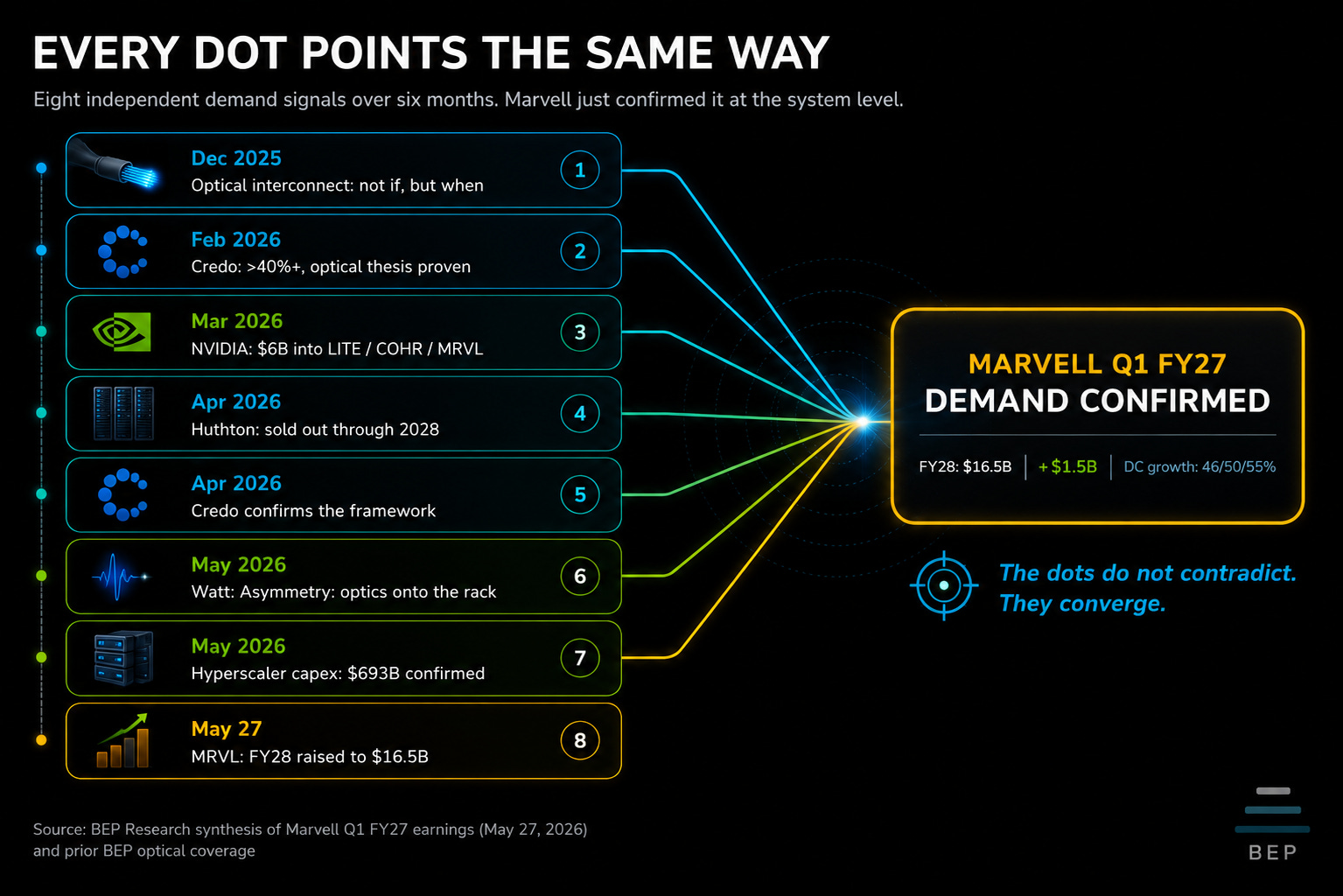
And it does not stand alone. The same demand has surfaced across this coverage for six months: the physics case that copper had to give way to optics, Credo’s record prints, and NVIDIA’s $6 billion deployed across the optical layer. The cleanest statement of it was The Watt Asymmetry, where one megawatt per rack meant “optics have to move onto the rack itself.” Marvell’s print is the next leg of that same physics, not just optics onto the rack but optics between buildings, and the first system-level revenue confirmation of it. Marvell is the eighth dot, and it points exactly where the other seven do.
For paid subscribers: the content-expansion map, the public read-through basket, the NVIDIA DSP risk, and the prepayment tell that says supply, not demand, is still the constraint.
