Are We In A Labubu Bubble?
You might be wondering: Are we reliving the dot-com bubble and Beanie Babies mania all over again?

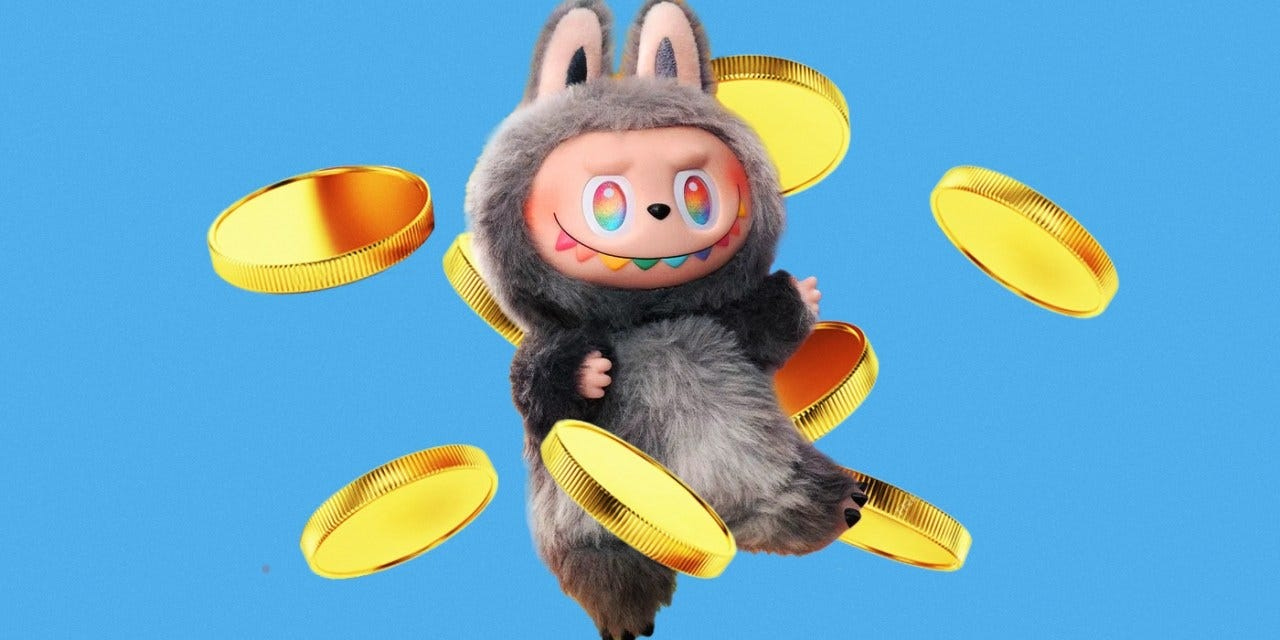
So far, we’ve seen how Labubu’s meteoric rise has enchanted collectors. But is it just a quirky pop-culture fad, or part of something bigger? To answer that, it helps to step back and compare Labubu-mania to another unlikely craze from a different era. In fact, today’s Labubu frenzy bears a striking resemblance to the Beanie Babies boom of the late 1990s – and both crazes unfolded amid much larger economic bubbles. Understanding these parallels can shed light on the forces driving such manias, from investor psychology to monetary policy, and what they mean for the broader economy.
1990s: Beanie Babies and the Dot-Com Euphoria
Bubbles Past and Present: Beanie Babies and Labubu in Context
So far, we’ve seen how Labubu’s meteoric rise has enchanted collectors. But is it just a quirky pop-culture fad, or part of something bigger? Your children might be bugging you to get one. To answer that, it helps to step back and compare Labubu-mania to another unlikely craze from a different era. In fact, today’s Labubu frenzy bears a striking resemblance to the Beanie Babies boom of the late 1990s – and both crazes unfolded amid much larger economic bubbles. Understanding these parallels can shed light on the forces driving such manias, from investor psychology to monetary policy, and what they mean for the broader economy.
1990s: Beanie Babies and the Dot-Com Euphoria
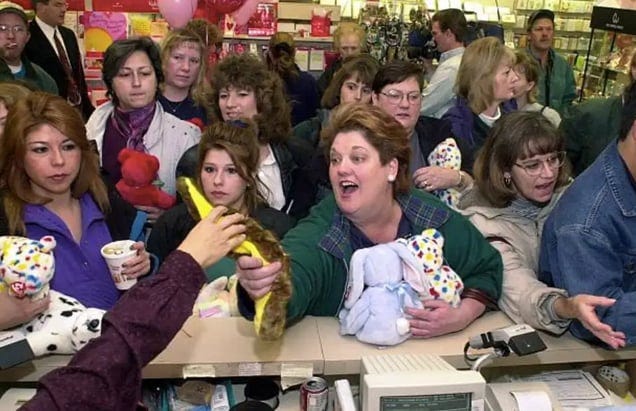
Crowds of Beanie Baby enthusiasts mobbing a store counter in the late 1990s illustrate the frenzy surrounding these plush toys at the bubble’s peak. The Beanie Babies craze of the mid-to-late 1990s wasn’t just a cute footnote in toy history – it was a microcosm of the era’s “irrational exuberance.” At the same time that Silicon Valley startups were soaring on optimism, bean-filled plush animals became the center of a speculative storm. Ty Inc.’s Beanie Babies, originally priced at just $5, suddenly turned into “must-have” collectibles fetching hundreds or even thousands of dollars on secondary markets . Like the dot-com bubble that sent the NASDAQ stock index up 80% in 1999 only to crash by 78% by 2002 , Beanie Babies were fueled by a potent mix of novelty, optimism, and fear-of-missing-out (FOMO). Collectors genuinely believed these toys were investments that could only rise in value – a classic bubble mindset. As one analysis noted, “the 1990s mania surrounding plush toys tells us as much about irrational behavior as the coincident dot-com bubble.”
Several factors fed this frenzy. Optimism and expanding markets played a key role. Just as the internet opened new markets for tech companies, platforms like eBay gave Beanie Baby sellers access to a nationwide (even global) pool of buyers, dramatically increasing demand and price transparency . Ty Inc. cleverly stoked the sense of novelty and scarcity by “retiring” certain Beanie models without warning, making each discontinued design suddenly more desirable. This manufactured rarity created a feedback loop: as prices shot up online, more people became convinced these toys were tickets to riches, further inflating the bubble. It was not unlike tech investors chasing any stock with a “.com” in its name. In fact, by the late ’90s many Beanie speculators had little genuine interest in the toys themselves – they were adults hoarding mint-condition bears and platypuses in plastic boxes, purely as “investment” inventory . One commentator quipped that a toy nobody actually plays with is perhaps the ultimate sign of a speculative fad . And indeed, once it became clear that Beanies were overvalued trinkets rather than a substitute for a 401(k), the Beanie Baby bubble popped spectacularly. By 1999, newly “retired” toys failed to spike in value as expected, panic selling ensued, and prices plunged over 90% within a couple of years . Those Princess Diana bears and Rainbow the chameleons that had once sold for $500 or more were soon worth virtually nothing on resale markets – a sobering reminder that even “investment-grade” collectibles can crumble when the optimism evaporates .
Importantly, the Beanie Babies mania didn’t happen in a vacuum – it thrived in the economic bubble of its day. The late 1990s saw a roaring stock market and an influx of easy capital. Tech IPOs were minting millionaires overnight, and consumers had a sense that anything new would only go up in value. Monetary policy set the backdrop: the U.S. Federal Reserve under Alan Greenspan kept interest rates relatively low and cut rates aggressively at the slightest sign of trouble (such as the 1998 LTCM hedge fund crisis), which flooded the markets with cheap money . Those “easy money” conditions made it simpler for people to splurge on speculative bets – be it shares of a loss-making dot-com or cases of collectible toys to resell. In fact, historians note that low interest rates in 1998–99 fueled a boom in start-up companies , and by extension, bubbly behavior in many corners of the economy. The Beanie frenzy was one quirky manifestation of the era’s excess. With cash and optimism aplenty, moms, dads, and college kids alike became speculators, convinced that rare “Princess” bears or “Garcia” tie-dyed teddies were their ticket to financial freedom. It’s a textbook example of how investor psychology, when pumped up by a booming economy and ample liquidity, can turn stuffed animals into a speculative asset class.

2020s: Labubu and the New AI-Fueled Hype
Fast forward to the mid-2020s, and we see history rhyming in fascinating ways. The Labubu craze – a viral collectible phenomenon – is unfolding against the backdrop of another era of heady speculation: the boom in all things AI (Artificial Intelligence). On the surface, tech startups and fluffy monster dolls couldn’t be more different. But the underlying drivers of their manias are strikingly similar. Just as the dot-com boom imbued the ’90s with a sense that anything Internet would turn to gold, today an AI investment bubble has been inflating, premised on the idea that anything AI will revolutionize markets. This has created a climate of speculative fervor and FOMO very akin to what we saw decades ago.
Consider Labubu’s rise. What began as a niche art toy in China has, by 2024–2025, exploded into “Labubunomics” – a full-blown economy of scarcity and resale. Small blind-box figurines that retail for $20–30 are selling out within seconds and flipping for double or triple the price online . Limited-edition Labubus fetch hundreds or even thousands of dollars on platforms like StockX and eBay. In one extreme case, a rare Labubu figurine sold at auction for $150,000 – an almost surreal price tag for a modern plush toy. Hype and fear-of-missing-out fuel this market: devoted fans set alarms for product “drops,” queue up at 4 a.m. outside stores, and frantically trade tips on Reddit for snagging the latest release . It’s not just kids driving demand, either. Celebrities like Rihanna, Blackpink’s Lisa, and Dua Lipa have been spotted accessorizing with Labubu charms, instantly amplifying the craze . Social media has turbocharged the phenomenon – TikTok videos of blind-box unboxings and “haul” posts have made the weirdly cute, big-eyed Labubu creatures into viral stars, spurring thousands of new collectors who don’t want to miss out on the trend. In short, Labubu has become the 2020s equivalent of Beanie Babies in many ways, complete with frenzied sell-outs, soaring resale prices, and a cultural ubiquity that leaps from toy stores to Instagram feeds.
Luxury meets “ugly-cute”: Two Labubu plush charms clipped to a high-fashion handbag in 2024, reflecting how this collectible craze has infiltrated street style and pop culture. What’s especially intriguing is how the Labubu craze aligns with the wider AI boom gripping financial markets. In the stock market, 2023–2025 has seen investors pile into AI-related companies with almost speculative zeal – reminiscent of how, in the late ’90s, merely adding “.com” to a company’s name sent its stock soaring. Today, a startup need only sprinkle some AI buzzwords in its pitch to attract speculative capital. By mid-2023, shares of companies like NVIDIA (a key AI chipmaker) surged to record highs on outsized optimism about AI’s future, and venture capitalists raced to fund AI startups at hefty valuations. Tech analysts have openly debated whether we’re in an “AI bubble,” noting parallels to 1999’s dot-com mania . The psychology is familiar: exuberance about a revolutionary technology (be it the Internet or artificial intelligence) leads to sky-high expectations, which leads to a flood of money chasing the next big thing. As one investment advisor put it, humans tend to become overly optimistic on the pace of adoption for new technologies, setting up unrealistic expectations ripe for disappointment . That optimism can morph into a speculative orgy, with investors fearful of missing the boat. In the late ’90s, “anything with a .com” was enough to justify a crazy valuation; today, “you just need some credible link to AI” to send a stock into the stratosphere . In other words, the same FOMO that drove people to hoard Beanie Babies is now driving investors to snap up AI stocks – and, in a more whimsical way, it’s also driving collectors to obsess over Labubus.
Labubu mania and the AI boom also share an important economic undercurrent: they both flourished in an environment of abundant liquidity and low interest rates. In the 2020s, years of ultralow interest rates and pandemic-era stimulus created a glut of easy money looking for high returns. When borrowing is cheap and traditional investments like bonds pay meager yields, people tend to seek out riskier assets – whether that’s speculative tech stocks, cryptocurrencies, or even collectibles and art toys. This environment has been described as a “wall of money” in the financial system, encouraging speculation and risk-taking behavior . Indeed, observers point out that the unprecedented monetary stimulus and near-zero rates of the past decade helped fuel a broad “everything rally,” from Silicon Valley valuations to the price of Pokémon cards. It’s no coincidence that the Labubu craze took off after 2020, when consumers had excess savings, stimulus checks, and a speculative itch (witness the GameStop-meme stock saga and NFT boom of that period). Easy money makes it psychologically easier to justify spending $50 or $100 on a cute blind-box toy on the bet that “it might be worth more later.” And for investors, the same low-rate environment made pouring funds into unprofitable AI startups seem reasonable – after all, if cash is cheap, why not bet on the next big innovation?
Crucially, central banks have only recently begun tightening the spigot. As interest rates rise again (in response to inflation), that easy-money fuel is starting to wane. History suggests that when the tide of liquidity recedes, speculative crazes often face a reality check. This was true in 2000 when the dot-com bubble met the cold hard truth of earnings and higher financing costs, and Beanie Baby prices collapsed accordingly. It may prove true for the current AI-centric boom – and perhaps for Labubus – if the economic backdrop continues to change. Some financial commentators have noted that today’s market vibe “feels closer to 1999 than not,” warning that the AI investment boom could be repeating the patterns of the dot-com bubble . None of this is to say that AI technology isn’t real or that Labubus aren’t genuinely delightful to fans; it’s simply a reminder that hype-driven valuations – whether of stocks or toys – eventually demand justification. As one wealth advisor quipped, the fault isn’t in the technology or the toy, but in our hubris as humans. We get carried away, assume trees grow to the sky, and overlook fundamental limits (be it a company’s lack of profits or the fact that a plush rabbit with monster teeth is, at the end of the day, just a mass-produced trinket).
The Role of Monetary Policy – Fuel for the Fire: A final parallel tying the 1990s Beanie bubble and today’s Labubu craze together is how monetary policy and macroeconomic conditions set the stage for each. In both eras, low interest rates and accommodative policy poured gasoline on the flames of speculation. During the late ’90s, the Federal Reserve’s actions under Greenspan (often dubbed the “Greenspan Put”) created a safety net in investors’ minds – rate cuts and bailouts signaled that money would stay cheap and markets would be backstopped . This encouraged risk-taking: why not invest in a zany e-commerce startup or buy a few dozen “rare” Beanie Babies when the economy is booming and credit is easy? Similarly, the 2010s and early 2020s featured historically low interest rates near zero. Central banks flooded the system with liquidity (through quantitative easing and stimulus) to fight crises, inadvertently encouraging a hunt for speculative returns. By 2021, observers were warning that “the titanic rise in central bank assets has ‘perfectly’ matched the strong rebound in mega-cap growth stocks” – in other words, the surge in liquidity was inflating a bubble in tech investments . That same wave lifted other speculative boats: crypto, NFTs, meme stocks, and yes, collectibles like Labubu. It’s telling that asset bubbles throughout history – from 17th-century tulip mania to the housing boom of the 2000s – often coincide with periods of easy credit and excess money sloshing around . When borrowing is cheap, asset prices inflate more easily as people leverage up and chase returns. Both the Beanie Baby craze and the Labubu/AI era illustrate this phenomenon vividly. Consumers and investors, awash in liquidity, bid up prices of assets that might seem irrational in harsher times. And when monetary conditions tighten (as they did when the Fed raised rates in 1999–2000, or as we’re seeing in 2023–2025), those speculative bubbles become vulnerable to popping. Low rates build the bubble; rising rates prick it.
Bringing It Together – Lessons and Transition: In comparing the Beanie Babies boom with today’s Labubu craze, we see a recurring story of hype meeting economics. Both crazes started with something fun and novel (a cute toy, an exciting technology) and escalated into mania as optimism and easy money kicked into overdrive. Both thrived on FOMO – whether it was ’90s parents scouring toy stores for a retired plush, or 2020s collectors refreshing Pop Mart’s website at midnight. And critically, both played out against a backdrop of larger bubbles (dot-com stocks then, AI and tech stocks now) driven by investor psychology and liquidity. This parallel offers a cautionary tale wrapped in an analytical insight: our behaviors in markets and consumer fads are often not so different. The names and faces change – Pikachu or Pets.com, Labubu or ChatGPT – but the underlying dynamics of human greed, hope, and herd behavior remain. As we move on to the next part of this discussion, it’s worth asking: what eventually happens when the music stops? The Beanie Baby bust provides one answer. For Labubu and the current AI craze, the final chapters are still being written. But if history is any guide, it’s wise to remember that economic gravity hasn’t been repealed. Collectibles and stocks alike still depend on real value in the end, and when a bubble forms, sooner or later it finds its pin. For now, the Labubu bubble hasn’t burst – and the excitement continues – but understanding these broader bubble economics gives us a clearer view of the road ahead. Ultimately, recognizing the bubble-like nature of such crazes can help investors and collectors alike temper their expectations and prepare for what might come next in this unfolding story.
Really good article. Hope you write more!